Just fifteen minutes from Fuerteventura lies Lobos Island, one of the best-kept secrets in the Canary Islands. Don’t be fooled by its size. This small island packs in a world of contrasts, from tranquil lagoons and dusty trails to a dramatic volcanic landscape that feels untouched by time.

Officially part of a natural park, Isla de Lobos is wild, raw, and refreshingly simple; a place where the loudest sound is the wind and the sea arguing over who’s boss.
You can spot Lanzarote shimmering across the strait, teasing you with its distant peaks while you crunch across black rock and golden sand. Most visitors make a beeline for the beaches, but for me, the real magic unfolded on the trail, a half-day hike that loops the island, climbs its highest peak, and leaves you both sunburnt and speechless.

Why Visit Lobos Island
Let’s clear this up first. Los Lobos is the band that sang La Bamba; Islote de Lobos is the tiny island off Fuerteventura where you’ll find peace, not guitars.
Barely above sea level, this speck of land is a tangle of volcanic rock, salt flats, and turquoise lagoons, officially protected as a nature reserve. Small enough to walk around in a few hours, yet wild enough to make you feel wonderfully lost, it’s one of those rare places where nature still calls the shots.
This island is the only place in the Canaries where such rugged simplicity feels so complete. The fauna is as unfazed as the scenery – lizards lazing on lava stones, seabirds gliding in slow circles, everything moving to the rhythm of the wind and waves.


How to get to Isla de Lobos
Most trips to Isla de Lobos start in Corralejo, the lively port town on Fuerteventura’s northern coast. From here, ferries shuttle visitors across the short stretch of water to the island’s tiny dock, the only entry point into this peaceful paradise. The journey takes about 15 minutes, just long enough to feel the salt spray on your face and forget whatever mainland chaos you left behind.
We booked our basic tickets through GetYourGuide, which ran like clockwork; on time, efficient, and stress-free. Ferries are limited, so book in advance, especially in high season. If you fancy something livelier, there’s a 4-hour sailing trip that includes snorkelling and drinks, or a speedboat option for a bit more action. Those after a flexible schedule can also hop on a water taxi from the same port.
To protect the island’s fragile ecosystem, a free permit is required for all destinations within the park. You can apply online ahead of time. The system is simple, but slots are limited, so plan a day or two in advance.
For the best experience, catch an early ferry when the air is still cool and the crowds haven’t arrived. We took the 10 a.m. boat over and returned on the 2:20 p.m. sailing, just enough time to loop the island, climb the volcano, and cool off before heading back to civilisation.

What to Pack
There’s no shade, no cafés, and no corner shops on Isla de Lobos, so whatever you bring is all you’ll have. Keep it light but clever. Here’s what actually matters:
- Light backpack: just enough room for essentials, nothing bulky.
- Sturdy shoes: volcanic gravel isn’t kind to flip-flops.
- Hat and sunscreen: the sun hits hard, even when it’s windy.
- Plenty of water: more than you think you’ll need; there’s nowhere to refill.
- Sunglasses: that volcanic glare is real.
- Camera or binoculars: for those panoramic views of Fuerteventura and Lanzarote.
- Tissues or wipes: no facilities on the trail.
We skipped the beach gear and didn’t regret it. Towels, snorkels, and floaties sound fun until you’re trudging uphill in the sun. Packing light made the hike easier and the sense of freedom even better.


Beaches or Hike?
On Lobos Island, the day boils down to two choices: beach towel or trail shoes. You can go sunbathing and swimming in the calm turquoise shallows at Puertito de Lobos, where patches of pale sand mix with dark volcanic rock, or wander to Playa de la Concha, a sheltered crescent that’s perfect for a leisurely swim. Between them lies Las Lagunitas, a chain of tidal pools that shimmer and shift colour as the light changes through the day.
We chose the hike, the full island loop, taken clockwise. It threads past those same beaches and Lagunitas, hugs the coast, and climbs Montaña La Caldera for sweeping views of Lanzarote and Fuerteventura. Fewer people, more variety, and that satisfying “we did the whole thing” feeling, plus no towels or snorkel kits weighing us down!
Both options have their charm. If you’re after an easy, laid-back day, the lagoon and Playa de la Concha are bliss. But if you’ve got good shoes and a curious streak, the island loop reveals the real island: wild, volcanic, and quietly spectacular.


The Clockwise Loop Hike
Stepping off the Lobos boat at the small dock feels like landing on another planet. The trail begins gently, following the boardwalk past the salt marsh of Las Lagunitas, where migratory birds feed in the shallow pools.
This opening stretch is flat and wide, giving you time to absorb the barrenness; the baked earth, the hush, the endless blue horizon. Even here, it’s clear that the Island of Lobos belongs more to the wind and sea than to people.
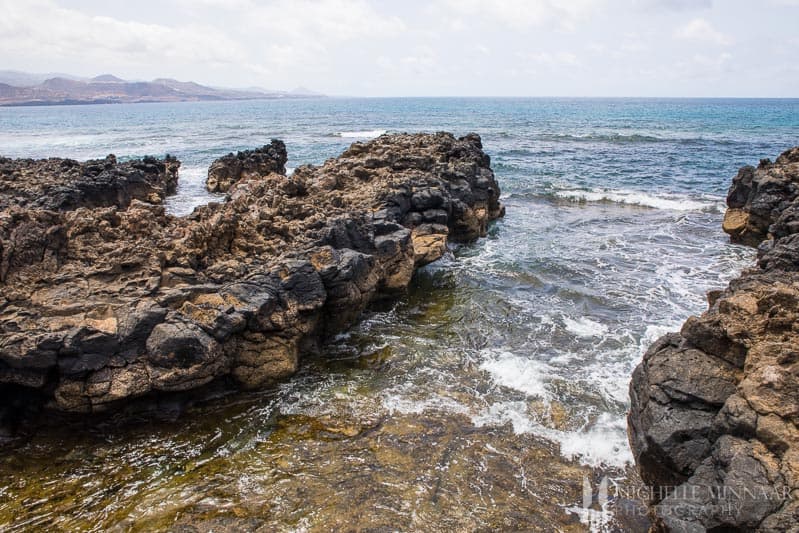
As the path curves along the west coast, the scenery shifts from pale white sand to jagged volcanic rock, broken by bursts of hardy flora clinging to the cracks. You’ll spot occasional natural pools shimmering in crystal clear waters, reminders that this is one of the natural areas protected as a Special Protection Area for seabirds and marine life.
The highest point comes next: Montaña La Caldera. The climb is steep but short, each turn revealing wider views: Lanzarote floating in the haze to the north, Fuerteventura sprawling behind. At the summit, the wind snaps and whistles, and it’s easy to imagine the monk seals (or sea lions) that once gave the island its name basking here before humans arrived.
From there, the trail descends toward the northern tip, where the Faro de Punta Martiño lighthouse keeps solitary watch. The final stretch follows the east coast, tracing lava-streaked shorelines and low dunes, the sea glittering under the midday sun.
We reached the dock with thirty minutes to spare – dusty, sun-flushed, and quietly elated. Four hours, one volcano, and a thousand shades of blue later, the island of Lobos had completely worked its spell.
Tips for a Smooth Trip
- Mind the trade winds: It can be breezy even when it’s hot. A light windbreaker beats shivering on the summit in sweaty cotton.
- Tide check = better swims: El Puertito has natural pools are tide-sensitive; a mid to high tide is usually clearer and deeper.
- Feet first: Volcanic grit eats flimsy soles. Low hikers or sturdy trainers beat sandals; reef shoes help if you’ll wade at Puertito.
- Electrolytes > extra snacks: You’ll feel the sun before hunger. One small sachet in your water bottle keeps you sharper than a granola bar.
- Stay on the designated track: The island of Lobos is fragile. Stick to the boardwalks and marked paths; shortcuts crush plants and disturb birds.
- Bathroom reality check: No facilities on the island trails. Sort yourself in Corralejo before boarding.


Final Thoughts
It’s hard to believe this tiny islet, just a few kilometres from Fuerteventura, holds so many different landscapes in one loop: salt marshes, black lava, pale dunes, and turquoise waters that seem painted on rather than real.
Standing by the lighthouse at Punta Martiño, I couldn’t help but picture the old lighthouse keeper, once living out here with only seabirds and the crash of the ocean for company. Further south, traces of local fishermen remain near the harbour, reminders that people once worked these shores long before day-tripping tourists and the occasional windsurfing board appeared on the horizon.
History lingers quietly here. Centuries ago, Spanish conquerors stopped at Lobos to restock and fish, drawn by its isolation and calm bay. Today, the same stillness remains, just fewer nets and more cameras. You reach it on a small ferry, not a galleon, and your spoils are photos, salt-streaked skin, and a satisfied grin.
There’s no café, no nightlife, yet that’s the point. Lobos is for those who trade comfort for curiosity. Four hours, one volcano, and a thousand shades of blue later, I stepped off the boat back in Corralejo, certain of one thing: sometimes the smallest places leave the biggest mark.